

Flyfishing Tips, Tricks, & Tactics
I hope some of these "rants" are helpful. If you have a topic you'd like me cover, email me at jeffconrad55@gmail.com and I'll write something up if I think I have anything meaningful to offer on the topic. ~ jc
Binary Thought Process:
I have arrived at the belief that fish go through a binary thought process when deciding whether to eat our flies of not. First of all, they have to be at least feeding opportunistically if not outright hunting for food before this thought process happens. Once they are interested enough to "assess" our fly I think their little pea brains go "my food behaves like that, so that must be my food", or, more often, "my food doesn't behave like that, so that's not my food." The decision they make as to whether to eat our flies or not is based on the quality of our presentations... the right depth (top, middle, bottom), the right behavior (dead drift, swooning/struggling, fleeing). With this in mind I'm always changing the behavior of my fly to see what action triggers their instinct to eat. This experimentation leads to more fish caught than just "Doing the Same Thing Over and Over Again and Expecting Different Results." HINT: I always catch more fish with a swooning/struggling type of action. Fish are bullies and they pick on the weak. I think fish and cats might be the same animal. Fish are just cats with fins;-) They exhibit similar behaviors of cats. They're territorial, covetous, grumpy, isolationist, and they love to play "cat n mouse" with their food. Did you ever see a pride of lionesses chasing down a herd of gazelle? They end up eating the one that is limping at the back of the pack. ~jc
River Smallmouth fishing is great for developing flyfishing skills:
To be successful as a river Smallmouth flyfisher you have to combine many skills that translate well to other forms of fishing. Essentially, you get to develop skills here on your home water that will help you be successful in many other fishing situations. Example... in order to be a consistently successful smallmouth angler in moving water you have to combine the following skills:
- Reading water to know where the fish may be holding.
- Smallmouth are cautious and smart - they require excellent approach and generally subtle presentation to get them to eat.
- Accurate casting - to put the fly where it needs to be under trees, around logs and rocks, etc.
- Repeated casting - on a float trip you'll probably cast 90-100 times per hour at least.
- Larger flies - smallmouth flies are either weighted deep water flies, larger mid-column streamers or med/lg topwater.
- Smallmouth require line control - drag is a killer and must be conquered with the Reach cast, full-line mend and tip mends of various types.
- Hooking and landing strong fish
So, where might we use these skills in other fishing situations?
- Trout nymphng and dry fly fishing - reading water, accurate casting, subtle approach, line control
- Streamers for big trout - reading water, accurate casting, repeated casting with large flies, line control, landing strong fish
- Saltwater flats/mangrove fishing - reading water, subtle approach, accurate casting (in the wind), landing strong fish
- Salmon/Steelhead fishing - reading water, line control, landing strong fish
- Pike/Musky fishing - casting large flies, line control, landing strong fish
The skills learned and practiced while fishing river smallmouth make you a better angler for all types of fishing... and you get to fish while you are honing these skills:-)
Relative water temperatures and fish behavior:
Smallmouth specifically (but all warmwater fish in general) seem to repsond to changes in water temperature more than they repsond to WHAT the temperature is. Ok... that sentence sucked, so I'll try to explain. As an example, in the late-Spring the water might be 58 degrees in the morning rising to 61, by 4pm. That small change in temperature will almost certainly inspire fish to feed more aggressively as the water warms. So, while at 58 degrees they could be sullen, at 61 degrees they seem to be happy to eat. The 3 degrees changed their behavior. Fast forward to mid-Summer... the water temp in the morning might be 72 degrees, and increase to 76 through the day. So, here's my question... if the fish were so happy to eat at 61 degrees in the late-Spring, why can they be reticent to eat at 72 degrees and not really turn on until the water has warmed some more? I have noticed this for years, so I guess I've decided it is the change in temperature that inspires their feeding more than the actual temperature itself. This comes to mind as shorter days and cooler night cause a wider change in water temps from night time to daytime. The effect is more pronounced with wider temp ranges. Anyway, watch this for yourself and lemme know if you see the same thing or if you think I might be crazy... or both.
Never, ever kick your flyline:
There it is on the floor of the boat, kinda in the way, getting stepped on and snagged. So, the idea comes to mind to just scoot it out of your way with your foot. You try and then notice that it is all rolled up and looks tangled. It is. That is the beginning of the end for the flyline. Rolling it under your foot begins the process of tearing the flyline coating... the PVC, away from the internal core, whether it be dacron, mono, or some space-age material. I can always tell a flyline that has been rolled under a shoe. They have a weird twist in them and are out-of-round. Soon they begin to crack in that area and life is over. If you take good care of a flyline you should easily get 4-5 seasons of hard fishing out of one. Roll it around with your foot and you get to cough up another $100 in a year or so. ~jc
Update on Flylines I'm Testing:
I love what is happening with flyline designs these days. The fascination with "distance at all costs" seems to be waning and the necessity of line control seems to be moving front and center. Scientific Anglers has introduced a few new lines that I think meet many needs.
We need to be able to move flies of all sizes a reasonable distance (maybe 40-60ft including rod extension and leader length) with relative ease. But more importantly, we need to be able to mend to control line and the presentation of our fly or flies. A fly thrown 70 feet and then dragging out of the strike zone is a useless display of athletics. A fly thrown 35-50 feet and then controlled for good presentation is a liable to result in a fish on the line. I can count on 2 hands the number of fish I have caught on casts over about 70 feet in my years of flyfishing... and the fish I did catch at those distances committed suicide by swimming away from me rather than toward.
The reasons I think we frequently miss fish at longer distances are:
- Delayed reaction to the strike
- Fly line and leader stretch of about 10%
So, the new trend is flylines has moved toward compound taper lines. Here are 4 lines I like alot. Just looking at the tapers and their grain weights can tell you alot about how they will perform in fishing situations. These are all untextured flylines as I don't care for the noise or feel of textured lines, nor do see any major advantage of using textured lines:
SA Titan Taper Long: A true compound taper offers a longer belly for better control of line on the water (mending), with a bassbug style front taper to move heavier and more wind-resistant flies. I've fished this line extensivley for warmwater species with heavy, large flies. Highly recommended for that job, but beware that this line is 2x heavy.
- Head is about 42 feet long
- Weight is 2x heavy (a 5wt is actually a 7wt, a 6wt is actually an 8wt, etc.) I put a 5wt on medium-fast 6wt rods and a 6wt on fast action 6wt rods. Both worked beautifully.

SA MPX: This is a wonderful general purpose flyline. A smooth compound taper loads the rod for heavier flies, but still provides some delicacy in presentation. A good solution if you're not a "line geek" like me and just want to go fishing for panfish, trout and bass with the same setup.
- Head is about 35 feet long
- Weight is .5x heavy (a 6wt is actually a 6.5wt)

SA Infinity: The Infinity is a brand new offering for 2018. It offers an extended head length of around 50ft with a subtle "bump" built into the front of the taper for loading the rod. It casts like silk and delivers a powerful but smooth presentation with flies up to size 1/0 deerhair bugs.
- Head length is about 50 feet
- Weight is .5x heavy (a 6wt is actually a 6.5wt)

SA Anadro: While not really a compound taper, I think of this line as an extremely long bassbug head with a long, smooth taper down to the running line. The belly is nearly 60 feet long! This is the only line I'm in love with on my Orvis Recon rod. Several of my fishing clients and casting students have really appreciated the feel of this line as well.
- Head is about 60 feet long - 35' of heavy head followed by about 25' of gradual taper down to the running line
- Weight is 1.5x (a 6wt is actually an 7.5wt)

Fishing Unweighted Streamers Deeper:
Unweighted streamers are frequently unweighted for a reason... because adding weight would mute the action of the fly. This is especially true with flies that are intended to "swoon"... to look injured and struggling in the water. Add weight to that kind of a fly and it loses it's action and plummets to the bottom. Examples of popular swooning flies are: Jack Gartside's "Beastmaster", Dave Pinckowski's "Bad Hair Day", Bill Murdich's "Murdich Minnow", Kelly Galloup's "Zoo Cougar", Lefty's "Decevier", Conrad's Predator Drone, Conrad's Wounded Minnow, etc. These flies are usually intended to fish just under the surface, maybe in the top 6-8" of the water column. But, when we want to fish these flies a little deeper, we have a few choices:
- Sinktip (or full-sinking) flyline
- Sinking leader
- Add weight to the leader
Rather than weighting the fly or fishing it on a sinktip line or sinking leader, I'll weight my leader using a tippet ring or small barrel swivel on the leader about 3 feet above the fly. Just the weight of the ring or swivel will help pull the leader down just a bit. Then, using flourocarbon for the tippet helps sink it a little more. If I want to get the fly even deeper, the ring or swivel is a secure place to put a small splitshot. This method allows the fly to fish deeper while maintaining it's action on a floating fly line. This works very well in warmwater fishing situations, but might be too much "stuff" on the leader in clear trout waters. In that case, a sinktip or sinking leader might be a better choice, but I'd try it this way first and see if you get refusals or no action at all. My use of this technique comes from my dislike of sinking flylines. I don't like fishing sinking flylines unless I have to because I can't manipulate the flyline to give the fly action. Sinking lines really only allow a "straight retreive. I like to use the "mend/twitch" (see below) and other ways of moving the flyline to animate the fly, which can't be done with sinking lines. Here's a sample rigging illustration. The starting leader and pound test examples are what I generally use for warmwater fishing. Adjust them according to your needs.

Mend/twitch retrieve:
When retrieving a streamer or popper, try moving the fly by doing small, quick mends of the fly line. Draw a quick “C” in the air (a small "C" and very low to the water) with your rod tip and then quickly recover the slack you have created. Watch the tip of your flyline.... however much the flyline tip moved is how much you moved the fly. Strive to move the flyline tip 3-6 inches and you'll be moving your fly in a seductive manner without pulling it out of the strike zone. This type of retrieve imparts a more jerky action to the fly than the tradtitional “strip and pause” retrieve. This is a must-do fishing tactic when fish are not aggressively chasing your flies.
Fish the cast you drop:
Many anglers have the tendency to drop a cast and pick it back up because they don't like where it landed. This is a terrible habit that spooks fish. Just don't do it. Whatever cast you drop... wherever it lands... just fish it out. You'll be surprised that you'll catch fish on casts that you thought were terrible. You'll also notice that you catch more fish on that second cast into the same area.
Use a Loop Knot for streamers and poppers:
The loop knot allows the fly to swim more naturally than if it is tied tight to the tippet. My favorite loop knot is the Non-slip Loop Knot. This great illustration makes it easy to learn the knot correctly.
- Step 1: Make a "granny loop"
- Step 2: Pass the tag end thru the eye of the hook.
- Step 3: Pass the tag end back through the granny loop, entering the same side as your tag end came out.
- Step 4: Pull the tag end and standing line at the same time to reduce the size of the loop and set it just at the hook eye. Whatever the size of the loop is, your final loop will be about twice that size once you tighten the knot..
- Step 5: Wrap the tag end around the standing line 3 to 6 times. (minimum 3 times for heavy line... maximum 6 times for light line).
- Step 6: Feed the tag end through the middle of the loop you have created.
- Step 7: Moisten the line and tighten the knot very slowly by pulling down on the tag end. This will help close the knot down and keep the loop from expanding to be too wide. You want the loop to be very small... just large enough to give the fly freedom, but small enough that there is no way for the fly to foul in the loop.
- Step 8: Give the standing line a sharp tug to seat the knot properly.
- Step 9: Trim the tag end closely.
- Step 10: Put some pressure on the knot to make sure it is solid. Always test your knots before the fish do it for you:-)

Illustration from the book "Essential Knots and Rigs for Trout" (Stackpole Books, Headwater Books, 2010) by Joe Mahler.
ANOTHER UPDATE ON ROD/LINE WEIGHTS:
With all of the new flylines on the market, there are now several things you need to consider when choosing a fly line, as follows:
- Grain weight
- Taper shape
- Texture
- Temperature rating
Grain weight - Using the chart below, you can determine what the original "weight" of a flyline was according to the AFFTA (American Fly Fishing Trade Association) standard upon which the entire flyrod/line balance system is based. When you see that a company calls a flyline a "6-weight" but it weighs 172 grains that is is actually a 6.5wt, or if it weighs 185 grains, you'll know that the line is actually a 7wt line. That will tell you that the line will load your 6wt rod deeply with a shorter length of flyline head outside of the tip guide, because, for example, a 6wt flyrod is supposed to load with 30 feet of a 6wt flyline weighing 160 grains in the first 30 feet. So, if the flyline weighs more than the rated weight in the first 30 feet, it will load the 6wt rod with less than 30 feet outside the tip. This makes the rod more capable of moving larger flies with less false casting, but can also reduce delicacy of presentation and even distance somewhat.
We need to begin thinking of a flyrod as a simple lever, like a seesaw. If both people on each end of a seesaw weigh the same (or quite similar) then the placement of the fulcrum in the exact middle works fine. But, if there is a drastic weight difference between the two ends, the fulcrum needs to be moved closer to the heavier object to provide a mechanical advantage (leverage) to the lighter end. With that in mind, think of fishing small-to-medium trout flies on your rod as "equal weight" on each end of the seesaw. In that case, the normally rated flyline weight should perform beautifully (5wt rod/5wt flyline). But when you need to throw large or wind-resistant flies such as deerhair bassbugs, large streamers, etc., it's time to "move the fulcrum" and overline the rod to provide the caster with a mechanical advantage. This is a hotly-contested topic among some flyfishing experts, rod manufacturers, etc., but no one can deny the logic of physics, although they try. Many of the people who have disagreed with me on this were doing so while fishing my 6wt boat rods with 7wt flylines and raving about how the easy the rig was to cast:-)
AFFTA Standard Flyline Weights (in the first 30 feet)
The numbers in the parentheses to the right are the new AFFTA weight "range" specifications. I guess they had to do this for the "math" to work out correctly and for flyline companies to be able to apply a general label to their flylines. I much prefer to use grain weight and taper shape to determine how my rod might react with a particular flyline on it.
- 1-weight; 60 grains (min 54 grains / max 66 grains)
- 2-weight; 80 grains (min 74 grains / max 86 grains)
- 3-weight; 100 grains (min 94 grains / max 106 grains)
- 4-weight; 120 grains (min 114 grains / max 126 grains)
- 5-weight; 140 grains (min 134 grains / max 146 grains)
- 6-weight; 160 grains (min 152 grains / max 168 grains)
- 7-weight; 185 grains (min 177 grains / max 193 grains)
- 8-weight; 210 grains (min 202 grains / max 218 grains)
- 9-weight; 240 grains (min 230 grains / max 250 grains)
- 10-weight; 280 grains (min 270 grains / max 290 grains)
- 11-weight; 330 grains (min 318 grains / max 342 grains)
- 12-weight; 380 grains (min 368 grains / max 392 grains)
- 13-weight; 450 grains (min 435 grains / max 465 grains)
- 14-weight; 500 grains (min 485 grains / max 515 grains)
- 15-weight; 550 grains (min 535 grains / max 565 grains)
Taper shape - Some tapers are long and elegant. Other tapers are compact and thick. The longer tapers will cast smoothly and mend well but may take a little more effort to move large or wind-resistant flies. The compact, thicker tapers front load the weight of the flyline to move big flies easily. However, they don't mend well and once the head is outside the tip top it casts like you are swinging a wet sock on the end of your rod. I personally prefer the smoother tapers and compound tapers such as Scientific Anglers produces.
Texture - I understand the theory that the texture minimizes drag against the guides. But the extreme textures cause a great deal of noise as the line travels through the rod guides and can even abrade your fingers as you strip flies. There are now softer textures that purport to still offer the advantages of texture without so much noise or abrasion. I don't personally like textured fly lines. I think improving your casting is the way to achieve more distance. Oh... and move closer to the fish. That helps, too.
Temperature rating - The biggest issue with the material in fly lines is when flylines are being used in extreme heat, such as in the tropics. When a traditional flyline gets extremely hot, the coating goes limp and and can be very inefficient to cast and even feel "gummy" to the touch. There are now specialty flylines to be used in extreme heat. These flylines have a stiffer coating that holds up in the extreme tropic heat. These lines are mostly targeted toward saltwater fishing. Not really a big deal in most cases, but don't try to use a "coldwater" fly line in extreme heat or a "tropic" flyline in extreme cold. Neither will function well. For the most part, general flylines function perfectly well in the normal temperature ranges of the northern hemisphere. Example: I recently fished my 8wt Orvis Saltwater AllRounder in 42 degree air and 50 degree water. It was a little stiff but still functioned well.
Let the Fly Teach You How To Fish It:
Every fly that we tie on offers possibilities for presentation. A dry fly might be fished dead-drift or twitched or even skated. A nymph or wet fly may be fished dead-drift, or caused to rise using the "Leisenring Lift", or even swam back toward the bank the way Walt Dette taught me to fish Isonychia nymphs and stonefly nymphs on the Beaverkill. Possibilities. The flies that offer even more presentation possibilites are streamers and topwater flies. Streamers, depending on their design, can be made to dart, die, jig, swoon, escape, etc. So, when I tie on a streamer, I'm always looking for ways to make it behave most effectively to attract strikes. For example, I tie a fly called a "Predator Drone". It's a streamer designed to swoon and die. By that, I mean the the fly is intended to look injured, and I fish it to enhance that impression by pulling it in short twitches (6-10 inch strips) followed by a pause where the fly stops and gets pushed around by the current. The design of the fly makes it come to life when it is sitting still... marabou and flash flutter, splayed hackle splays out, and the fly wobbles in the current. However, If I were to strip the fly quickly it wouldn't have any of the attractive "injured" behavior that I get by the twitch 'n' pause retreive. With poppers, many people fish them too hard and actually scare fish with them. Poppers can be twitched softly, dead-drifted, pulled under and caused to swim under water, or chugged along. All of this is to say that if you experiment with different presentations you can get some pretty attractive actions out of a fly pattern. To assume that dry flies and nymphs are only to be dead-drifted, or streamers are only to be swung, or poppers are only to be chugged along is to limit the fish-attracting possibilities of the fly pattern. Try different presentations to create different actions.. Also, tie your streamers and poppers on with a non-slip mono loop knot (see above) and their actions will be automatically improved by the freedom that knot allows.
Smallmouth Do "Spook":
Many anglers have the idea that Smallmouth are extremely aggressive all the time. Sometimes they are, usually during pre-spawn and sometimes when low light and warm weather collide. But aggressive doesn't mean "fearless". Even though they will attack with a vengeance, that doesn't mean that loud, aggressive flies or sloppy presentations won't send them finning for cover. What Smallmouth really are are "bullies". They'll attack defenseless looking things like they are the toughest punks in the parking lot... that is, until something acts tough itself. Then they turn into the chickenshits that bullies really are, and run for cover. The moral is that softer presentations catch alot more fish consistently than loud, obnoxious presentations. It's kinda like meeting girls... the loudmouth might get some temporary attention but the quieter, polite guy usually goes home with the real "catch".
Drag-free drift... but JUST BARELY:
It's easy to accomplish a drag-free drift if you throw an extra 10 feet of line on the water, however, it makes setting the hook nearly impossible. So, I try to accomplish a drag-free drift JUST BARELY. By dropping the cast "already mended" with a Reach Cast, or immediately doing a Full-line Mend when the cast hits the water, I set myself up for the repeated small "tip mends" necessary to keep the cast drifting drag-free with only a foot or two of extra line on the water. These repeated small mends are sometimes referred to as "stack mending"... stacking one mend on top of another to keep your fly floating drag-free. Every cast offers its own challenges in terms of a good presentation. If you look at the goal of a drag-free drift and experiment with different types of mends you will find yourself adding to your library of mending skills and recognizing when to use them to improve your presentations. Don't just stand in one place and do the same thing... you know what Einstein said about that. Change your position by a few steps, your depth, your mending pattern, and then your flies. Make 30-35 casts and then change something if you haven't had a strike... but the last thing you change is your flies.
The Water Column is a Complex Thing:
We are conditioned to look at moving water "horizontally", assessing what's happening across the top of the current. There may be a fast tongue of water running through the middle of a pool with an eddy on one or both sides, etc. I noticed that my nymphing skills improved when I started think about the water column in a vertical fashion as well. The water on the top of the water column moves the fastest (when it is unimpeded by obstructions). The water on the bottom moves slower because it is contacting rocks, sand and rubble on the stream bottom. The water on the bottom also causes an upwelling and a backwards spin as it progresses downstream contacting and bouncing off of rocks and other obstructions. This is evident in the roiling on the top of the water where the upwelling appears to "bubble up". So, there are 2 things that impact indicator/nymph presentation: 1) The top of the current moves your strike indicator faster than the nymphs below are moving, causing the nymphs to be dragged downstream and pulled up in the water column... not good. 2) The upwelling can cause your nymphs to be pushed upwards and not sink into the bottom 3-5 inches where the fish tend to sit to avoid fighting the stronger currents directly above them. The only things I have come up with to help combat these problems are as follows: 1) When I drop my cast I try to make sure the nymphs land downstream of my indicator using a hook cast or a quick mend of the indicator. This allows the nymphs to sink quickly and provides at least a few feet of drift where the indicator and nymphs are "inline" above the targeted slot I am fishing. 2) In rigging my nymphs, I use flourocarbon (which sinks), I use the lighest leader butt I can get away with and still turn the flies over (which also helps sinking), on a 2-fly rig I use a Copper John or other heavy fly as the first fly in the chain, I think of the first fly as "a weight with a hook". The point fly may or may not have weight to it. Then I use a single large split shot rather than several small ones strung along the leader. It's a work in progress for me, but this is what I've learned so far. Hope it helps. Holler back if you have other ideas or more detail. I have been experimenting with putting the weight on the end of the leader and the flies above. I still suck at presenting that, so I'm no help there yet.
Mending is key for many types of fly fishing:
Mending is often thought of as a skill only necessary in nymphing or dry fly fishing. However, mending is also necessary for proper presentation of streamers and topwater flies. Mending can be used very effectively to both animate flies and prevent drag. For example, to fish a topwater fly, you might cast across a faster current into softer water at the edge of a drop-off, or into a rock garden that slows and roils the water... primary ambush points for river fish. When you drop that cast, the faster water instantly starts dragging the flyline downstream and creating a belly in the line. This drag begins moving the fly out of the strike zone at a steady speed. Then, when you add your strip to the fly it is sped up even more and rushes away. Unless the fish are crazy aggressive, this seldom brings a strike. However, if you throw an upstream reach cast or an immediate full line mend (see below) and then maintain the upstream position of your flyline by continuous small upstream mends of the flyline (see below), you accomplish 2 key things that make your presenatation much more desirable to the fish; 1) You keep your fly sitting in the target water (the strike zone). And 2), the small upstream mends you make, twitch the fly slightly to give a sign of life and tease the fish into striking. To make these small mends, I draw a small "C" in the air, low to the water, with my rod tip. Perhaps an 8-12 inch "loop" is all. Big mends will yank your fly out of the strike zone. These mends will sometimes cause you to have more slack line than is ideal for the hook set, but I prefer battling that slack rather than not needing to make a hookset because no fish hit the fly. Of course, sometimes you'll cast across slow water into faster water. Adjust your mending accordingly by mending your line downstream in the slow water. Much harder to do, but ya gotta try!
I think of two different types of mends and two different methods to accomplish them. The "full line" mend is intended to move your entire flyline from where it landed on the water to another parallel location... usually upstream. I frequently use this when I first drop a cast with a complex nymph rig such as 2-3 flies/weight/strike indicator. The way I perform the full line mend is to raise the entire rod above my head parallel to the water's surface and then move the rod forcefully in the direction I want the line to move. The amount of force necessary is determined by the amount of line you have cast (and the action of the rod... softer rods make easier mends. Longer rods make easier mends. It is best to do this mend immediately after the cast lands so the line doesn't have too much time to "dig in" to the miniscus or move downstream too far. The "tip mend" is intended to adjust the position of a small portion of flyline and is used to extend/continue an already good drift. If you are nymphing or dry fly fishing, you will be attempting to adjust the position of the line on the water without moving the fly. If you are streamer or popper fishing, you may be intending to adjust the line without moving the fly, OR to reposition the line and twitch the fly in an enticing manner. In any case, learning to mend effectively is a sure way to increase your catch rate and therefore, your enjoyment of flyfishing. There are many other types of mends, including my favorite "in the air" mend, the Reach Cast, which I recommend every flyfisher learn and use frequently. Learn the mending techniques. Read the water. Plan the mend. Solve the presentation problem. Don't just let the current drag your fly out the strike zone.
Rod Weights/Line Ratings:
The line ratings for fly rods are just the manufacturers educated opinion of what line will cast best on that rod at about 30-40 feet. However, that doesn't take into account what fly (or group of flies) you will be fishing, what fishing situation you will be in, or your personal casting style. When you test a rod, try it with 3 line weights... the recommended weight, one weight heavier and one weight lighter... and tie on a fly with the hook cut off or some yarn to add casting resistance. This will give you a real sense of how the rod will perform at different ranges. My personal experience is as follows:
1) Most rods cast their rated line weight just fine with light or small profile flies... it's when you tie on a heavier or more wind-resistant fly that the rated line weight doesn't load the rod "deeply" enough to move the large fly easily at normal fishing ranges.
2) When casting the bigger flies we tend to throw for warmwater species, most rods need to be "over-lined" by one to two line weights to perform well within reasonable fishing ranges. Over-lining may limit your casting distance a bit as your rod begins to "fold-up" while extending the distance. Usually not a problem, though... in most normal fishing circumstances, the absolute maximum reach needed to catch fish is about 60-70 feet (which includes rod length, line length and leader length), and a majority of fish are caught within 30-45 feet. As for determining if you need to overline by one or two sizes, test both. My general experience is that slower rods cast better with one size heavier and faster rods with two sizes heavier, but definitely test for yourself to see what works for your casting style.
3) The reason for "under-lining" a rod is to cast farther with light flies and make a softer presentation. For example, if you were fishing Hebgen Lake in Yellowstone, casting midges 60-80 feet on fine tippets for spooky trout sipping on the surface, under-lining could be an advantage in softer presentation and the fact that your rod doesn't have to strain to cast the line an extended distance. Another application for underlining is when you are fishing in heavy wind on the flats for bonefish as the lighter line has less mass and "cuts" the wind somewhat easier. The problem with under-lining is that the rod doesn't load until you get 40+ feet of line out, so working out the first 40+ feet takes practice.
The main thing to remember is that the rod is capable of casting more than just it's rated line size, and adjusting up or down in line size can be a very effective way of "tuning" your casting to make fishing easier and more effective. In fact, in the past, rods were often rated for multiple line weights. In the old days, you would see rods for "6-7 line" or "5-6-7 line". The rod manufacturers finally figured out that they were losing rods sales by advertising that capability, so then rods began being rated for only one line size.
The "Escape Strip":
I've been subconciously doing the "escape strip" for years, until finally it dawned on me what I was doing. Fish are fast... alot faster than we could every strip a fly. Fish also love to play "cat 'n' mouse" with their food. I've watched them do it thousands of times. So, one of the stripping techniques I use starts by stripping the fly in tiny, short, jerky pulls of 2-3 inches. (Of course, you have to have the rod tip down and have the fly line and leader quite straight to even make any noticeable movement of the fly.) Then, after some number of the short, rather jerky little strips, I will strip once or twice in 8-12 inch pulls, letting the fly sink after the long strip. Watch the tip of your flyline closely. If it pauses, jerks, or otherwise behaves differently, set the hook. My thinking is that the fish are nosing up to the fly, swimming behind it and "toying" with it. Then, when the fly attempts to escape by moving faster and farther, the fish jumps the fly and inhales it. This has worked enough times that I incorporate it into my fishing quite frequently with both submerged flies and topwater.
Tying beadhead flies:
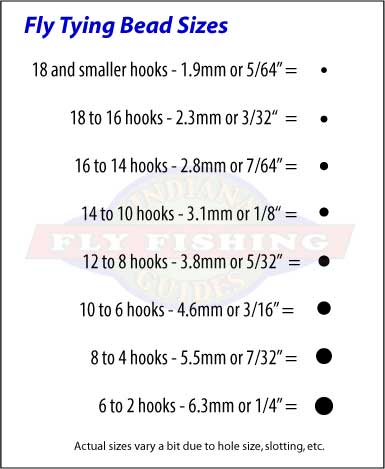
The sizes of beads for fly tying has always confused me, so I put together this little chart to help me remember. Maybe it'll help you, too. Sizes will vary among different brands, but this chart should at least get you closer to making sure you don't buy a bead the size of a green pea when you're trying to tie size 18 Prince Nymphs:-)
Better presentation of sinking flies:
While I am a fan of the artful turnover of a well-tied leader, there are times when getting a sunken fly "truly sunken" requires sacrificing the perfect turnover and going with straight mono (or flourocarbon) in whatever tippet size balances the fly correctly. The reason is that the stiffer the leader the more it resists sinking and sinks at an angle rather than allowing your fly to plummet straight down. I admit to using extremely heavy flies for years to combat my leaders' unwillingness to sink. I've finally wised up. Rather than fighting the sinking problem, I just cut my leader back to the butt section and tie in 6-8 feet of tippet to balance my sinking fly (usually 6-10lb test for most warmwater sinking flies). The fly plunges to the bottom and I'm fishing deeper sooner. I'm also able to use flies that are lighter in weight and might not knock me out if I hit myself in the head with them:-) This works for retreiving flies and for indicator nymphing a sunken fly.
Mono vs flouro:
Flourocarbon is expensive stuff, but it has a few properties that make it invaluable in certain ways:
- It doesn't rot like mono does.
- It is more abrasion-resistant than mono.
- It is (supposedly) less visible to the fish, although I haven't personally asked any fish which is less visible.
Here's what I came up with to help me decide when to buy flouro over mono: I buy flourocarbon tippet material in sizes 2x and smaller for trout and steelhead fishing (nymphing and streamers). Since it doesn't rot and weaken over time like mono does, it actually saves me money on replacing tippet sizes that I don't use very often. For heavier than 2x, I use mono.
UPDATE: I neglected to mention that flourocarbon sinks, so, while it is great for nymphing and streamers, not so much so for dry fly fishing... it'll drag your flies down. Same goes for popper fishing. Stick with mono for dry flies and poppers.
UPDATE AGAIN: Kelly Galloup suggests using a short section of flouro as the end section of your tippet when dry fly fishing... perhaps 8-12". Watch the video. His reasoning is that the flouro sinks just a little in that short section and helps you avoid the visibility created by mono floating right up to the fly. Makes sense to me. Kelly is a clear thinker on fly angling tactics, so I'll be trying this the next time I get to fish dries.
Tippet/Hook Size Balance Chart:
The following table shows the correspondence between tippet weights and hook sizes to balance the presentation of the fly. Using this chart as a guideline, a tippet choice should be made by considering the following factors:
- The air-resistance of the fly: If the fly is bushy, choose the heavier tippet for that hook size, and conversely, if the fly is sparse choose the lighter of the tippet sizes.
- The spookiness of the fish: If the fish are interested in your fly but making last minute refusals, try lengthening your tippet slightly or changing it to one size smaller. Warning: air-resistant flies tend to spin fine tippets into a birdsnest.
- The desired action of the fly: Sometimes the desired action of the fly will override hook size as the determining factor in tippet selection. Ex: a streamer will sometimes have a better jigging action if fished on a lighter than normal tippet (within reason).
- The size/strength of the fish being targeted - Sometimes this trumps all other considerations.

Of course, the tippet used has to be balanced by being attached to a leader designed to turn over that weight of tippet and style of fly. Example: You wouldn't want to try to cast a size 1/0 bass bug on a 0x tippet attached to a light trout leader. As a general guideline, the heavier the tippet you need to use, the heavier the butt of the leader needs to be to provide energy transfer from the flyline, through the leader to the tippet/fly. Leader butts can can vary widely from a light trout leader where the butt might be as light as .017" (and limp) to heavy bass/salmon leaders where the butt might be as heavy as .040".
If you are planning on buying extruded leaders, remember that most extruded materials are more limp than level (non-extruded) mono. For general warmwater flyfishing, I recommend buying heavier ones such as 7.5ft 0x bass or saltwater leaders, then trimming the tippet back 8-12 inches, tie a perfection loop in the tippet end, and then tie your tippet to the loop.
For my general warmwater flyfishing I tie the following leader butt/turnover sections:
Heavy Butt Leader: 8wt - 10wt rods
- 36" of 40lb test
- 18" of 30lb test
- 8" of 25lb test
- 8" of 20lb test
- 8" of 15lb test
A lighter version for the low, clear water of Summer (and the resultant smaller flies): 5wt - 7wt rods
- 36" of 30lb test
- 18" of 25lb test
- 8" of 20lb test
- 8" of 15lb test
- 8" of 12lb test
These make excellent 6.5 foot leader butt and turnover sections. Tie a perfection loop in the butt end to attach to the flyline, and one in the tippet end to attach the tippet. You can attach the tippet loop-to-loop or just tie it on to the perfection loop. Use 2.5 to 3.5 feet of tippet to make a 9 to 10 foot leader. I use Maxima Ultragreen material. For general purpose saltwater leaders, I use these same recipes but use Mason Hard Type Nylon or quality flourocarbon, which is much stiffer for good turnover on long casts in the wind and more abrasion-resistant.
To barb or not to barb:
Those who believe strongly in barbless fishing often don't really consider their viewpoint from a common-sense position. I was one of them. I believed that barbs were the end of all evil and anyone who used them was a "barb-arian". (Sorry). Then I started thinking about it (rationally) one day while fishing a size 18 nymph to an 8lb Erie Steelhead. I realized that the barb itself is not so much of a problem... it's the size of the hook/barb in relation to the size of the fish. Should I have worried about the tiny barb on that #18 nymph causing injury upon removal to the large Steelhead? It would be a mere pinhole in his jaw reminding him that humans are peckerwoods and he should stay away from them, but it would cause no lasting damage. If I were tarpon fishing, should I worry about a #2/0 hook in a massive tarpon. Again... no contest. On the other hand, ANY barbed hook stuck in the jaw of a 10" Trout or a 12" Smallmouth can do some real damage because of the way you have to handle the fish to wiggle the fly out. So, here's what I came up with... I fish barbless when the size of the hook versus the size of the fish could cause any harm to the fish. I fish barbless when there are other people around who could get hooked. I fish barbless when the shirt I am wearing cost more than $5. I fish barbless because I don't like tearing my flies up trying to get them out of fishes mouths. I fish barbless because I don't need a barb to hold on to a large majority of the fish I hook. Then I fish barbless for everything else anyway because I don't like handling the fish too much and I don't like causing the fish anymore stress than I have already caused him by fighting with him and pulling him out of his habitat. I fish barbless, well... all of the time. But when I go to Florida to fish tarpon with my buddy Capt. Pete, I think I'll leave the barb up and feel ok about it.
A nice trick for securing metal eyes to a hook:
Take an emery board and sand a little of the lacquer coating off of a bronze hook. Wrap the thread into place, add a drop of super glue on the bare hook area, place the eyes on the super glue, position them quickly and wrap in with thread. This gives you a “metal-to-metal” bond. Use figure eight wraps, locking wraps, and encircling wraps to secure them in place. The super glue will soak into the thread and make a very strong bond. Let the superglue dry. This will prevent the eyes from spinning around the hook shank. No need to sand down stainless hooks. Just add the super glue for a metal-to-metal bond. If the metal eyes are painted, also scrape some of the paint off to expose the metal. (Thanks to Junior Burke for this tip!)
Developing Solid Flyfishing Technique:
There is nothing like the repetition of correct casting technique to build muscle memory. And while flycasting is a group of elementary movements of the hands and arms, the part that needs practice is putting those disparate motions together into a well-timed flow to generate a smooth cast with enough line speed to get the fly to its target. After you master the basics of flycasting (on the lawn, ponds, etc.), there is simply no better way to really learn to cast (and fish) than to take float trips with guides who are good casting and fishing instructors. On the average, you will cast 90-120 times per hour for the duration of the trip. You'll will be asked to put the fly tight to cover, against logs, under trees and right over rocks. Meanwhile, the boat is moving, there are trees behind you, the flyline needs to be adjusted on the water (mending), the flyline inside the boat needs to be managed (because you are probably standing on it), and there is usually another person 10 feet from you trying to do the same thing. There is no other flyfishing situation that will accelerate your learning curve the way fishing a river from a moving boat will. Oh... and its great fun!
Use the right equipment for the job:
(don't bring a knife to a gun fight)
Flycasting all day can take alot out of you. An adequate flycaster can throw a popper or weighted streamer with a 4 or 5wt rod. But can you (or would you want to) throw that heavy fly 90-120 times per hour for the duration of a 9-10 hour float trip? Probably not. Many anglers bring "trout rods" to fish for Smallmouth. They usually wear out quickly or get frustrated with the extra false casting required to move a larger fly with an underpowered rod. Most end up using my boat rods, which are 6wt rods which are "over-lined" with Scientific Anglers Titan Taper Long lines and heavy-butt leaders. These rods provide the efficiency you need to cast 1000+ times during a long float trip, and you'll actually fish more because you are limiting the false casting and are able to cast farther, quicker.
Choosing ONLY the Right Equipment:
Take a common-sense approach to choosing your equipment. Don't buy a rod/reel/line setup of every weight. Instead, choose a light, medium and heavy rig and you will build yourself an arsenal of equipment that will cover most of your fishing for the rest of your days. ex: a 4wt rig, a 6wt rig and an 8wt or 9wt rig should cover everything from bluegill to salmon and mid-sized saltwater species. If you are headed out to fish for tarpon, sailfish or other giant species, you will usually be doing so with a guide who will provide the rig you need for the species.
Rod Tip Down: (I CAN'T STRESS THIS ENOUGH)
When fishing streamers or poppers, put the tip of your rod right at the surface of the water or even in the water and inch or so. This creates a direct connection between you and your fly, which does 2 things:
- Rod tip down maximizes the number of takes that turn into hooked fish
- Rod tip down enhances the action of your fly
When you have slack line between you and your fly, you are really just retrieving the slack and the fly is being pulled in by the slack, which imparts little action to the fly. Also, fish are incredibly fast at taking in and then spitting out our flies. If you are directly connected to the fly, chances are much better that you will have the opportunity to set the hook when a fish eats.
Nymphing in Warmwater:
We all like the visual take of a fish slamming a topwater bug or chasing a streamer. Unfortunately, the fish are in control of this game and our job is to present the flies they will eat in the manner they want to see them. Indicator nymphing can be effective when other methods are not producing. Try a lightly weighted crayfish pattern, Wooly Bugger, Hellgramite, or even a small Clouser Minnow. Put the fly under an indicator about 1 foot deeper than the estimated water depth you are fishing. Look for the fly to tick the bottom while being pulled downstream by the indicator. You can impart more action by twitching the indicator a bit or mending it upstream for a dead drift. Since nymphing is usually used when more active tactics (streamers or poppers) are not drawing strikes, don't just float the fly through a hole or run once, but rather anchor up and "nymph" the water, adjusting your depth, presentation and fly until you have fished the water thoroughly.
Strike indicators Montana-style:
(Montana-style since I learned it from Chris Connor, a great fishing guide on the Madison). Montana-style is a simple way to attach a teardrop strike indicator to the leader so it is perfectly inline and doesn't cause snags. Before you tie on any flies, thread your leader down through the top (fat end) of the strike indicator. Then pass it back through the top again, encircling the strike indicator in the leader. Then move the strike indicator to the desired position and torque down on the leader a little bit so it cuts into the strike indicator foam. It will stay in place through hard casting and repeated strikes. When you want to adjust it, simply loosen the mono around the strike indicator, place your finger in the loop and slide the indicator in the desired direction. I use high-density polystyrene Floatmaster indicators for this. Don't try this with many of the indicators that are made of cheaper foam as they will split in half when you try to torque down on them. I like the Airlock indicators as well, but they do protrude from the leader making it easier to "wrap" your flies into a tangled mess in the windy casting conditions especially common out West. Another newer option is the Oros strike indicators. Two halves of a round foam strike indicator screw together on the leader with an internal plastic screw/nut. A good idea, but I have noticed some slippage of the indicators no matter how hard I try to tighten it on the leader, especially on lighter tippet sizes. It's always give and take in choosing indicators. Some are light and land softly, some are heavy and splash down, some stay in place, some slip, some damage the leader and some don't, some cause tangles and some don't, etc. I think I'll stick with Montana-style for now, but if Oros adds a rubber washer inside their indicators to prevent slippage then I think I'd move that direction.
Low Water Smallmouth:
Switch to less visible (more impressionistic) fly patterns as the water drops and clears. Try Clouser Minnows or Murdich Minnows tied sparsely with synthetics. My favorite synthetic for these purposes is called "Slinky Fiber" (single color), "Slinky Blend" (mixed colors), and the Steve Farrar blends of Slinky Fiber with subtle flash. It doesn't tangle together like as badly as most synthetics and doesn't collapse into a thin profile when wet. Also, during low water times, reduce the size of your topwater poppers and use the quieter flies such as deerhair divers, small Sneaky Pete's or Stealth Bombers.
Surface Flies on Sink-tips Lines:
You can offer a unique diving presentation by fishing a floating popper on a sink-tip line. This presentation makes the bug dive when stripped and causes it to suspend below the surface when left to drift. This can work when fish are aggressive but surface-shy, and can be effective with Todd's Wiggle Minnow, Sneaky Pete's, Dahlberg Divers, deerhair streamers, etc.
Popper With a Dropper:
Add some extra spice to your popper presentation with a dropper 3-4 feet behind. Use a Clouser Swimming Nymph, Wolly Bugger, a Spoon Fly or other "swimming fly" on 3-4 feet of 2x to 4x tippet tied to the bend of the popper hook. Each time you twitch the popper the trailer does it's dance and can draw strikes from fish that won't come up for the popper. I use this technique during the transition season into late-Spring to test the waters and see if the fish are "looking up" yet while still fishing below the surface to maximize the chance of catching fish.
Ambush points:
Actively feeding fish will set up in places where they can hide from their prey and jump out for the kill. Examine the water for such places. Common ambush points are behind rocks, at the end of sweeper logs, holes downstream of anything that interrupts the current (points, logs, rocks), on the downstream side of a sunken log laying across the current, in piles of smaller branches, etc. Think like a predator to catch a predator. Fish look for:
- Safety (cover from predators)
- Rest (not fighting current)
- Food (right near a source of food being delivered continually)
Find those three attributes combined in a piece of moving water and you have a good chance of finding fish.
In stillwater, look for places where water flows into the lake, out of the lake, drop-off (shelfs) where the depth changes drastically from shallow to deep, rocky areas that could hold bait or crayfish, and any structure such as logs, decks, boat docks, etc. Fish like to hang out around things to hide under.
Fishing the spawn:
Don’t pester actively spawning fish. In the time they are away from their nests, bluegill, crayfish, etc. can strip the nest of eggs or Smallmouth fry. During spawning season, fish the faster, deeper water for non-spawning fish and leave the shallow spawning beds alone. Expect a few weeks of lull in the fishing after the spawn... the "post-spawn funk". Generally, in central Indiana, I just skip fishing rivers in June and leave the poor fish alone. There are plenty of other fishing opportunities in ponds, etc.